Tacx FLOW review
This review is for the Tacx FLOW Ergo trainer

Nutshell Review:
Pros:
-Great value for an ergo trainer
-Built in roll down calibration for repeatability
-Scaling ability to change calibration
-Repeatable setup ( cam actuated mount, cam setup at wheel)
-Two modes of operation, Ergo, and slope
-Lots of options on the display
-Includes cadence sensor
-Includes front wheel mount
-built in HRM that works with a Polar chest sensor
-Includes special skewer for mating to stand
-Upgradeable to the Tacx I-Magic for computer control of resitance unit, graphics, and programing, data download, etc...
-Available from Nashbar making returns easy
Cons:
-Suspect accuracy at high speeds, and high/low cadences
-Noise/vibration/harshness at high outputs
-response time to changes in wattage not immediate
-some creaking when out of the saddle
-Some quality control issues.
-Terrible manual.
Perspective of this review:
This trainer is used almost exclusively for intervals at set Power outputs. Most of the time this is done in the ERGO mode, where a wattage setting is entered, and the trainer holds that wattage regardless of cadence. I have no need for graphics or "spin-scan" features.
Other trainers I have used include the Cyclops Fluid, and Kreitler Rollers.
Setup:
I usually leave the bike in the stand for long periods of time, so don't really have a feel for how easy it is to put in and take out. But I do know that it is much easier than the Cyclops we have.
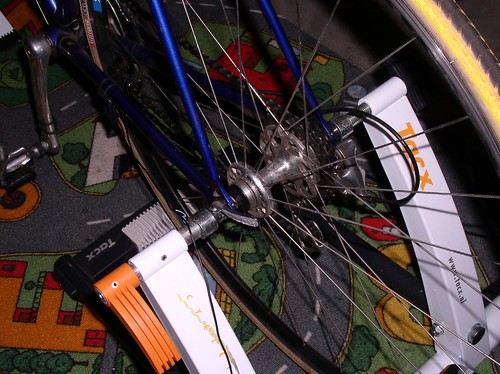
If you can see, the quick release is a special one that comes with the trainer. The end of it is shaped to fit into the stand perfectly. The orange handle is part of a cam system, so once the initial tension is set, it is repeatable. This is NOT a weight weenie quick release. I used to change it out, but now I just leave it on there.
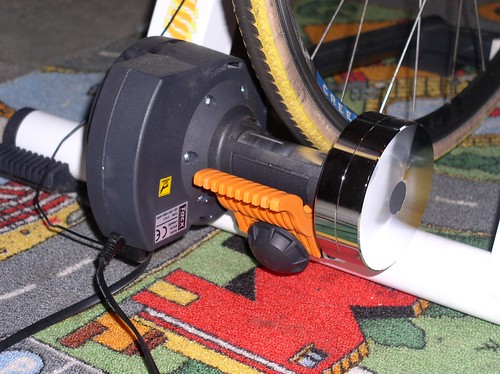
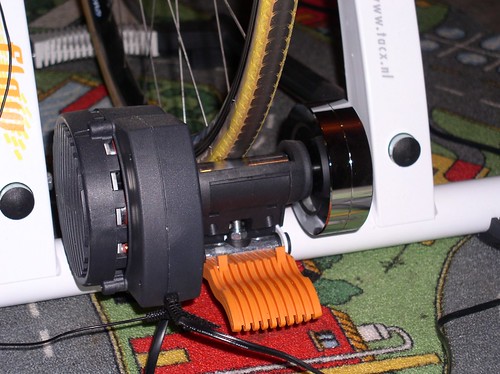
The tension between the load unit and the tire is also a cam setup controlled by a dial. It is counter intuitive but you dial it out to make the tension harder, and in to make it easier. But the cam lever makes it repeatable which is nice
Open position:
Closed position:
There is also a cadence sensor that mounts to the chain stay via a rubber band/hook sort of thing with a very small wire that runs back to the load generator. Be careful of snagging it as it looks pretty delicate. There is a long cable that connects the load generator to the head unit. This is a telephone type connector at the end.
Calibration:
The Flow has a built in roll-down calibration in it. I recommend that you ride for at least 5-10 minutes to warm it up before calibrating. And try to pump up the rear tire to the same amount every time. I use 8 Bar, and air is lost on a daily basis so you have to remember to pump it up.
You press two buttons for 10 seconds and it takes you to the setup menu. Your weight and display options are entered, and then you are in the calibration mode. Press the start button and the display says "Speed Up" start pedaling faster and faster until the display says "Stop". The computer calculates how long it takes to roll to a stop and it displays a number between -4 and +4. I usually then adjust the rear tension until I can get it to calibrate to 0. The dial on the tension is really sensitive and small increments are suggested when changing the tension.
Sometimes if you pedal too fast you get an error, but for the most part is is pretty straightforward.
I read about, but have not done the Scaling feature. This allows you to scale your power readout. If you use another power device, such as a power tap or SRM to make comparisons, I guess you can use this scale factor to make corrections to the Flow output. I will discuss more later the results of some other's comparisons of power output on the Flow to SRM /Power tap and some of the potential inaccuracies of the FLOW.
The Display unit:
The display unit is pretty nice and allows you some customization. there are two lines of readout. You can choose which piece of info is put on top and on bottom. I think your choices are:
-Watts
-HR
-Speed
-Cadence
The one that is on top will correspond to the top most clock. The top clock also shows an arrow if you are below the average for that metric.
I almost always have cadence on top and Watts on the bottom. And rarely do I use the top clock's readout for any info.
Modes of Operation:
There are two modes of operation:
Slope and Ergo.
In Slope mode, you set the trainer between a # -4 and +9. There is no correlation between this setting and an actual % grade. It is just a resistance level. And then your wattage is a straight calculation from your speed. The faster you go the higher wattage you are doing.
You can use this mode to calculate your average wattage over time. I don't like to use this setting too much when doing intervals at a set power level because it requires constant monitoring to stay at a certain power level. Though I do like this mode for the rest portion of the interval.
Here is a graph that I found of someone using an SRM on the FLOW in slope mode:
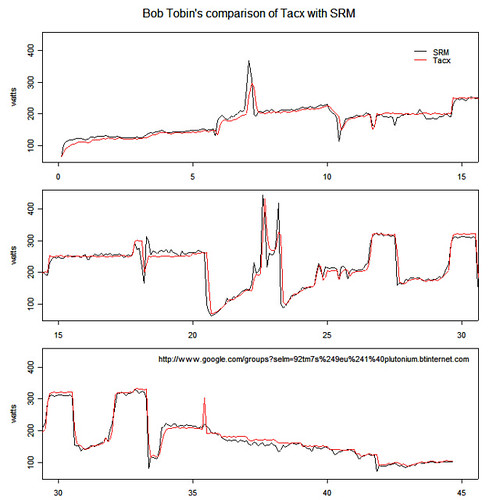
from the looks of it the FLOW tracked the SRM fairly well.
In ERGO mode, you set the power and the load unit supposedly maintains that power level regardless of your cadence. I really like this mode for doing intervals, because you just set it and put your head down and go.
The unit allows you 10W increments. I've found that there is a delay when you start ramping up the wattage, before the load unit responds.
There is some issues with the accuracy in ERGO mode. Just from observation I found that at high cadences it seems easier at a given power setting. Here is a graph where the same guys tracked the error of the Flow vs the SRM at a variety of cadences/speeds in the ERGO mode:
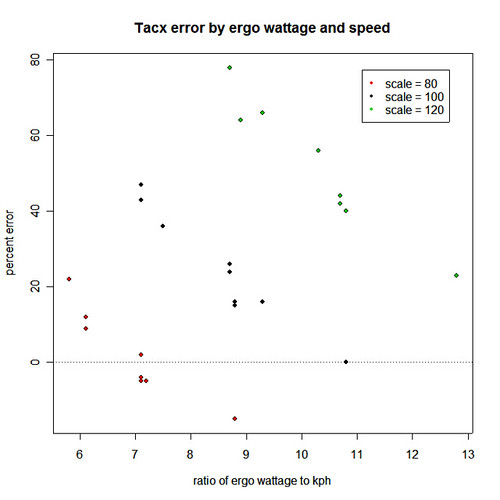
Here is a direct cut/paste explaining the data:
The chart may be a bit hard to interpret so I should probably explain. The idea of an ergo is that you set the wattage you want (say, 250W) and off you go (Ron Popeil would say, "set it and forget it"); the ergo will match the load so that whatever speed you ride, you'll be generating 250 watts. So in an ideal world you'd want the percent error to be independent of your speed. The chart plots the error against kph (or, in this case, the ratio of the wattage setting to the speed), and if the ergo worked well
the pattern would have zero slope.
The observed pattern doesn't have zero slope.
Instead, it says that in ergo mode the Flow's electronic braking system fails to increase the load by the appropriate amount to keep power constant as wheel speed increases. If you look only at the black dots (where the scale factor is set at 100), it says that if you set the ergo for a constant 250W, the Flow will only have zero error if you're riding at 23kph. At 28kph, the Flow is only able to produce enough braking force to generate an actual load of about 200W (about a 20% error). At 36kph, the Flow was actually producing about 40% less load than it should have. The scaling factor moves the curve up and down, but doesn't fix the basic underlying problem.
The good news is that the error is stable and predictable. The bad news is that the slope of the error is huge, which sort of defeats the entire intent of the ergo feature.
I have also read of some people who found that when you upgrade the FLOW to the I-magic with a PC computer control of the load generator that these errors go away, and that the control of the unit seems more stable.
The I-magic provides a bunch of video-game style graphics, and you can even get a steering addon that is supposed to be pretty fun. But what intrigues me about it, is the Cadence software that comes with it that allows you to program in your own rides. This would be great for me to program in these interval workouts because I am always losing count of what rep and what set I'm on. It would make things really easy.
Also the computer interface would allow compatability with Peaks Coaching sofware for analysis of the ride.
When cadence falls below a certain level, it feels like the brake force gets excessive as if it is compensating for the lower cadence. The actual cadence will vary depending on what gear I am in, so if I'm in my highest gear I can get down to the mid 60s before it bogs down, but two gears up the cog set and that cadence is in the mid 70s.
Noise/vibration
Like any trainer, when you are hitting it pretty hard you get some noise. This one makes a high pitched whine. When using headphones/MP3 player I can drown it out no problem. There is some vibration that comes through the bars that can sometimes cause some tingling, but I think any trainer would do that.
When standing up, like any fixed trainer you can't rock the bike beneath you. The stand does creak on me. But I haven't tried to tighten the setting.
And like any trainer, it will eat your tires.
Conclusions:
I bought this unit from Nashbar with a 20% off coupon and from their returned goods bin. So I got it for like under $250. You cannot even get a Computrainer Stand (just the stand) for under $200. Given that the most basic computrainer goes for $800 new and holds it's value pretty well used, the Tacx Flow is an incredible value IMHO. Power taps and SRMS are also more expensive, but allow you to take it outside, though do not have ERGO capability. It puts power training into the reach of more people.
I think normal price is $379 and if you are patient you can find a 20% off coupon sometimes.
For someone using the trainer for simple intervals I think it fits the bill very well. Yes there is some suspect accuracy in the ergo mode. But I think the repeatability of the unit is very high, which means that when you are using the numbers only in comparison to yourself than it doesn't really matter.
When I do these intervals, I've found myself at the ragged edge, which regardless of the accuracy means that I am working as hard as possible which is always the final intent.
And when just riding on it, I like the feel of the tension when compared to a Cycleops. Not sure how to describe it, but if I just want to soft pedal and go easy it just feels more natural on the FLOW (in slope mode ) then the Cycleops.
Hope this is of use to those looking for a trainer.
----------------------------------
*** Long term updates.
I've had one problem with my trainer. I unhooked everything to take it on vacation and when I hooked the cadence sensor back up it was dead. I was able to order a new cadence sensor cable for under $10 and was back in business. Other than that it's been fine.
A friend got a new Flow 1/2007 and it was working fine at first but then the head unit died. It was registering power but not registering any data flow. He had bought it from a reputable dealer (Lick Bike) and they are in the process of getting him a new head unit.
They said head unit before he told them that we troubleshot it using my unit/cable and had isolated the problem at the head unit. So I suspect that this problem is no surprise to them.
Also he had a difficult time with the instructions and w/o info from here would not have understood the slope/ergo modes and how to use them. So the manual that comes with it needs some work.
*NOTE **2-20-2007
It seems that calibration does not hold throughout the workout. I set the calibration to zero after a warmup. Later in the workout, sometimes I'll check the calibration again and it will be at -1 or -2. It seems to be a constant as my friends FLOW does the same thing. I either increase power if I'm feeling good at the end or just keep it like it is.
posted by Ashwin Amanna @ 2:32 PM
62 comments




62 Comments:
I just wanted to say thank you for posting this information on the trainer. I've been taking a cycling class where we use a computrainer which I love, but I can't justify spending $1500 on a computrainer, even if it is for my own health. I came across the Tacx FLOW while searching for trainers that include WATTS in the display and thought this might be a really good middle ground for developing an aerobic base indoors and for when it's wet out.
I'm thinking I might go ahead and get this one, based in large part on your review. I'll check out nashbar and see if I can muster up a 20% coupon while I'm at it. Thanks again for the review...
Great review. I'm trying to figure out if I can do a 30 min TT on my flow and find my Avg Watts for the 30 mins.
To do a time trial I think the way is to use the Slope Mode.
Get it all warmed up and calibrated. Then switch it to slope mode at a setting that equates to what a flat road feels like to you.
Then hit the two main buttons together just briefly enough to reset the counters to 0.
Then ride for 30 minutes and set the head unit to show Wattage on top and set the topmost line to show average watts.
Your wattage will change in relation to gearing or slope changes but that is just like what a real time trial would be like.
Honestly, I haven't done this protocol yet so don't know exactly if it will work.
Thanks for the help. I did a 30min TT this morning. I ride 650c and I had some trouble calibrating to 0. Because I was running out of time I just jumped on at -2. Not sure how this would effect the Avg Watts? DO YOU?
These are my numbers.
Cali -2 (start)(end) -2
TIME: 30:09
Wattage
MAX 384
Avg 318
19km
39.8 Km/h
37.8 Avg
These numbers do seem a little fast for me this early but are not way off. I guess having started at -2 would mess with the results?
For the last couple of years I've been spinning and doing interval workouts. It's worked great for this. For 2007 I want to do 30min TT once a week and track my improvements.
Thanks for the great imformation!
Thanks for the write up, I've finally decided this is the one for me. I'd like all the VR fancy-pants bits but can't justify the cost right now, but it's good to know it's upgrade-able.
Just found your blog and great post on the tacx flow. I've had one for the last few months and its a really useful bit of kit.
One question I had about the test between SRM and Tacx Flow - do you know how they got the data off the tacx? I've been toying with the idea that it should be possible to intercept the signal on the way to the head unit and send it to a computer to log remotely - using the computer as the head unit? I know the tacx is upgradable and all - but how do you rate my chances of finding a 'home' solution to this problem?
Any advice appreciated.
Not sure how they got the data. I think they upgraded to the Imagic head unit and downloaded it from there. But somewhere I read about a guy that compared his pre upgrade and post upgrade Flow and that it was more accurate after the upgrade, but I don't know how he got the data off it.
I think your idea is sound, just tap off the data wires that are going to the head unit and feed it into a computer. But the devilish details I don't know how to do. It'd be cool to get that data going into a labview interface or something.
I like the Imagic upgrade. It seems really neat from the ability to pre-program intervals as well as program the resistance unit to follow a course (Tour De France route, etc) and for logging data.
I just know that I'd fall into the paralysis of analysis trap. Right now it's enough for me to have a certain # to shoot for during an interval, and either you can do it or not.
Great article, thinking of getting one of these
Virtual Cycling
great review and tech info on the tacx flow,
googled for info on the cadence sensor and came up with your site. i am also team MWC 40some and absolutely no generic talent.
Have had to use my turbo trainer more as the weather here in the UK is turning alot colder
Read some of your other posts, great blog
cheers
Thanks for this great review! Awesome info and a real help. I own one of these, but after reading this I know so much more about it, you're right about the manual though...rubbish.
Thanks, Andy
i guess if you warm up the FLOW far below your interval goals you will notice a change in heat at the brake after you start your intervals... and thus a change in calibration. i find that warming it up for a half hour with some decent chunk of time near my interval wattage helps get through a workout without needing to recalibrate. maybe it's like doing a workout twice but, hey, it just makes me stronger.
I passionately trust that the critical information provided is strongly related everyone . Thanks a lot .
locksmith pembroke pines fl
Locksmith in Wellington
Locksmith Walnut Creek
Locksmith Santa Clara
Santa Clara locksmith
Locksmith Santa Clara
Locksmith Santa Clara CA
Locksmith Santa Clara CA
Locksmith Chicago Heights
Chicago Heights Locksmith
Chicago Heights Locksmith
Locksmith Chicago Heights IL
Chicago Heights Locksmith
Locksmith Chicago Heights
Locksmith Chicago Heights IL
Chicago Heights Locksmith
Locksmith Chicago Heights IL
Chicago Heights Locksmith
Locksmith Chicago Heights
Locksmith Chicago Heights
Chicago Heights Locksmith
Chicago Heights Locksmith
mesquite locksmiths
mesquite locksmiths
locksmith plano texas
mesquite locksmiths
locksmith fort worth
plano locksmiths
plano locksmiths
plano locksmiths
plano locksmiths
locksmith plano texas
locksmith miami
locksmith fort worth tx
locksmiths fort worth
Nice blogging, My review is very good example.
Lindsay Rosenwald http://www.lindsay-rosenwald.net/ Dr. Lindsay Rosenwald is one of the re-known venture capitalists and the hedge fund managers in the world
Nike Outlets Online
Nike Air Max 2011
Nike Air Max 24 7
Nike Air Max Bw
Nike Air Max Tn
Nike Air Presto
Nike Air Max Ltd
Nike Air Zoom Kobe
Nike Air Max Boots
Vibram Five Fingers Shoes
Nike Air Max Fitsole
Nike Air Max Goadome
Nike Air Max Skyline
Nike Air Max Turbulence
Nike Air Wildwood Supreme
Nike Outlet Stores Online
Nike Outlet Mall
Nike Air Griffey Max 1
Nike Air Max 1
Nike Air Max 180
Nike Air Max 87
Nike Air Max 90
Nike Air Max 91
Nike Air Max 95
Nike Air Max 2009
Nike Air Max 2010
Monsieur Louboutin once said, "sexy is too vast to be defined, but more than anything it's an attitude much like elegance." Christian Louboutin sale is the perfect juxtaposition between sexiness and elegance. Whether you dress her up or dress her down, she will add a bit of attitude to any ensemble.
The Cheap louboutin shoes designer’s ethos is to "make shoes that are like jewels" and each unique design demonstrates unparalleled quantity and an innate sultriness. Ladies are crazy about Christian Louboutin shoes. If you want keep the same pace with the trend. Christian Louboutin sale could be your best choice.
Welcome to our Cheap louboutin shoes online shop.With Christian Louboutin Heels,you will be the remarkable focus anywhere you went. Christian Louboutin Pumps was made for the lady who is feminine and confident. Christian Louboutin sale styles are worldwidely known as fashion icon now and their own cumbersome sleek try looking in colorful enchanting shades can always stand out from other people to produce a stylish design cheap louboutin shoes. Christian Louboutin sale is exactly about it’s conventional boot building, that is time-honored and remained to our time concerning it’s matchless comfort with snug fit.
Good pos tthanks!
i truthfully enjoy your own writing kind, very remarkable,
don’t give up as well as keep writing due to the fact that it simply just worth to follow it. looking forward to see a whole lot more of your current well written articles, enjoy your day
I was truly reluctant to check out your article the first time I saw the page layout of your blog. But I was greatly amazed on the post you have written. This is exactly what I've been looking for. I learned so much about it. It's very creative and exceptional. Nice work!
There may be a large amount of value that you have presented in this article, and studying the following responses and debate has really been intriguing, many thanks. Locksmiths Edinburgh
This article is so interesting I am completely engrossed. Really I appreciate the efforts you take for making these posts. Thanks for sharing with us such useful information.
I really liked your article. Keep up the good work.
nice site, and beautifull article.
I am happy that I found your blog. This is really interesting.
There Is Obviously a lot to know about this. I suppose you made Some Great points in the Feature also.
Digital Marketing Agency
Excellent site, keep up the good work my colleagues would love this.
Digital Marketing Agency
This comment has been removed by the author.
This is a Great Website You might find Fascinating that we Motivate A person.
Kids Logo
That's really massive exposure post and I must admire you in this regard.
Nice blog, its great article informative post, thanks for sharing it. Thanks for the information!
Internet Shop
Your tips are really acceptable but users wants accuracy and speed. I think which are not available in this so, how we use without speed as compared to other software's
Regards,
Susan Gray,
Anonymous said...
Thanks for the help. I did a 30min TT this morning. I ride 650c and I had some trouble calibrating to 0. Because I was running out of time I just jumped on at -2. Not sure how this would effect the Avg Watts? DO YOU?
wholesale cheap jerseys
nfl jerseys cheap
cheap mlb jerseys
Sure he’ll have a very good read. Thank you for sharing!
Thanks for posting this! I'm very much into scrapbooking and the materials cost a fortune, I'd love to get them with a discount.
Great to read about that. I was just searching for this. Well, I love the design of your website, I will be waiting for further updates.
I think one of your ads triggered my internet browser to resize, you should put that on your blacklist.
I've found it very helpful. There must be charging stations everywhere.
Nice blog with a great content, very usefull.. thanks
Great website, you find very usefull informations.. thank you
Now that is a what i call a great blog. Very informative and useful for people like me. Thanks for sharing with us.
Hello there, I should say it is a clever posting. I’ll certainly be seeking in on this web site yet again soon.
This is very interesting. thanks for that. we need more sites like this.
Sure he’ll have a very good read. Thank you for sharing.
Thanks you so much. This post is very help full for me a lot. Thanks for sharing nice post.
This passage is really very good content, theme classic, unique views, I think is worth seeing, thank the authors of shares. Hope the author continue to share!
The blog is good enough, keep up writing such type of posts.
This is what I am looking for. I like it very much and my style search come to end. Debt Collector
Thanks for your great article friend, i get new information, new ideas to do somethings, i hope you will share again, i keep waiting for next post, thanks. Debt Collection
Your work is carry the information to the other people. There is no question against your interesting blog. I am waiting you give me a more interested information. Debt Collection
thanks for this post very helpfull
regards
Syera Sites
http://www.syerasite.com
Olshopper | Online Shopping
http://www.olshopper.com
http://tuyulemon.com
http://kontes-seo.tuyulemon.com
http://syera.tuyulemon.com
http://id.linkedin.com/pub/syera-syailendra/46/2a3/839
Syera Syailendra
http://id.linkedin.com/in/serpwarrior
ItuPoker.Com Agen Poker Online Indonesia Terpercaya
http://how-to-blogger1.blogspot.com/2013/09/Agen-Poker-Online-Indonesia-Terpercaya.html
ITUPOKER.COM AGEN POKER ONLINE INDONESIA TERPERCAYA http://www.syerasite.com/2013/09/itupokercom-agen-poker-online-indonesia.html
Thanks for this great post...
This information is interesting to read, thanks
baju profesi anak
I read the article its a nice article its have lot of information thanks author for the nice article. Amazon Promo Codes
American Eagle Promo Code
AutoZone Coupons
Barnes & Noble Coupon Code
Barneys Warehouse Coupons
bebe Coupon Codes
Bed Bath and Beyond Coupon
Best Buy Coupons
Bluefly Coupon Codes
Groupon Promo Codes
Haggar Coupons
JcPenney Coupons
Kohls Coupons
Light In The Box Coupons
Macy's Coupon
Next Day Flyers Coupon Codes
Overstock Promo Codes
Sears Coupons
SmartBargains Coupons
Target Promo Codes
Walmart Coupon Codes
Woot Coupon Codes
This is good site and nice point of view.I learnt lots of useful information.
Airport Taxi
informative thanks for the sharing
Seo Company
I Really like this post very informative and knowledgeable thanks for the great post.
just wanted to say thank you for posting this information on the trainer. I've been taking a cycling class where we use a computrainer which I love, but I can't justify spending $1500 on a computrainer, even if it is for my own health. I came across the Tacx FLOW while searching for trainers that include WATTS in the display and thought this might be a really good middle ground for developing an aerobic base indoors and for when it's wet out.
Really good read for me, Must admit that you are one of the best bloggers I ever saw.Thanks for posting this informative article mainan edukasi
I think this is one of the most important information for me. And i am glad reading your article.
great post inspirational thank's
Jinpoker.com Agen Judi Poker Online dan Domino Online Indonesia Terpercaya
I think this is one of the most important information for me. And i am glad reading your article. thank you for sharing.........
Post a Comment
<< Home